
So excited this is finally published – I waited for 14 months from submission to acceptance! For an early career scholar like me, it was agonizingly long! But I am delighted to finally share the findings.
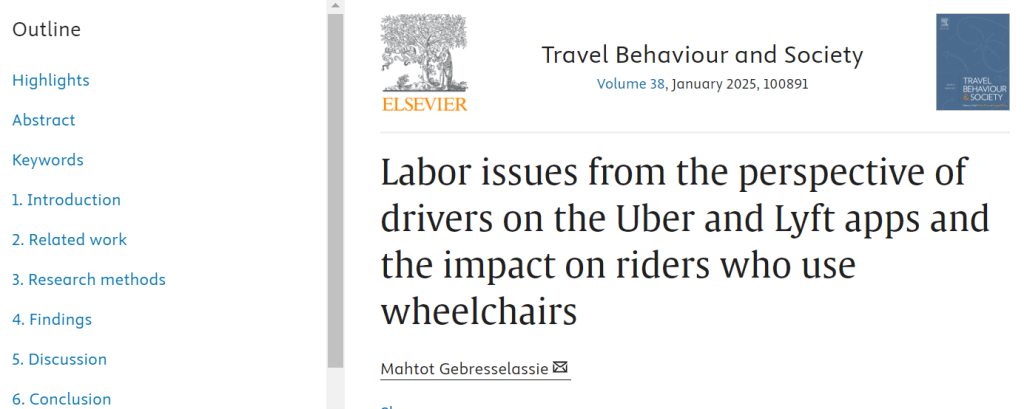
I interviewed drivers on the Uber and Lyft apps. They share that it takes longer time and more work to transport wheelchair users; that they are not compensated for the extra labor and time; and that for some of them, such labor issues on platform work (along with the precarious nature of work and their own disadvantages) discourage them from picking up wheelchair users. Here is what one of the drivers said:
“When you’re a rideshare driver, you have to have a mercenary-type mentality. You’re out there to make money for yourself or your family and you know everything else in my way be damned. The more time you spend with one particular person, the less time you spend getting other rides. So theoretically, there’s really only so much you can expect from a single rider. You’ll get whatever fare it is and you might get a tip. So, you know, a lot of people don’t want to take the risk of not getting tips and having to do all that extra work [helping wheelchair users] and maybe missing other rides.”
You can find the full article here.
Please cite as follows:
Gebresselassie, M. (2024). Labor issues from the perspective of drivers on the Uber and Lyft apps and the impact on riders who use wheelchairs. Travel Behavior and Society. doi.org/10.1016/j.tbs.2024.100891

 Mahtot [Mah-tote] Gebresselassie, PhD